
|
|
 Melissa Miles
Matrix Timeline
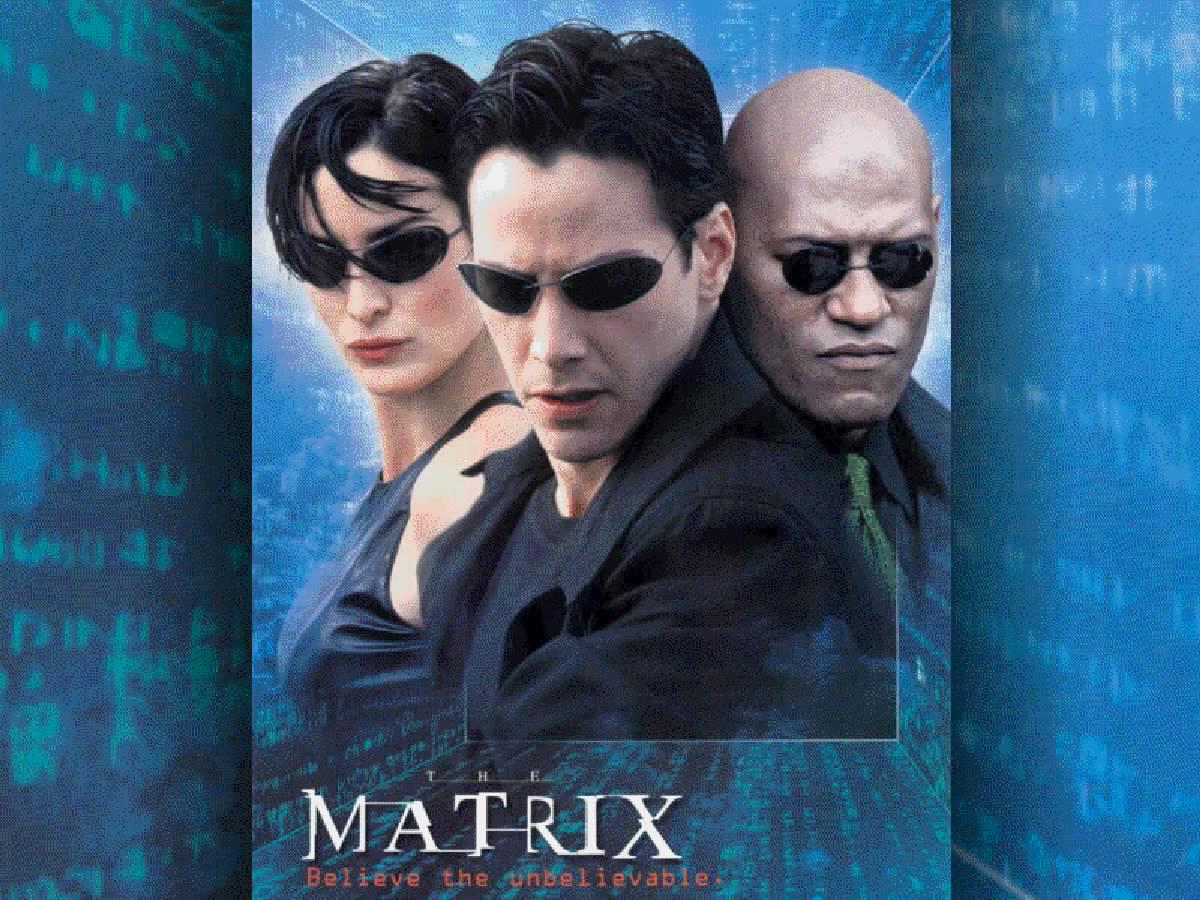
The film "The Matrix" begins by presenting the world that we know, and the world we assume is reality. The protagonist, Neo, is visited by a mysterious woman, Trinity, who then introduces him to a legendary cyber presence named Morpheus. She promises to answer the question, "What is the matrix?" This question has haunted Neo through out his hacking career.
However, he is not yet ready to let go of the world he knows until he is threatened by "agents" (government or otherwise, we aren't told) who have mysterious powers to persuade and intimidate. At this point, Neo's frame of reference begins to be compromised. Reality begins to appear strange and unpredictable. Again he is offered the choice to learn the answer to "What is the matrix?"
Morpheus describes Neo as an Alice falling down the rabbit hole, crossing the boundaries of the dream world. Morpheus offers him the choice of two pills to take (extending the Wonderland allusion). Blue will allow him to wake up to the reality he has always known and believed was real. Red will thrust him into the light of the truth, and give him the answer to the question, "What is the matrix?" Neo chooses the red, and there his (and our) adventure begins. Ironically, it is difficult to attempt to deconstruct "The Matrix" because it is essentially a postmodern text. In fact, it serves as a bridge between two 20th century art forms: science fiction and postmodernist fiction. The question of how to deconstruct a postmodernist text which by it's nature is undecidable is similar to the scientist who is dealing with the indeterminacy of a particle he is studying. Just like the particle, only aspects of this film can be examined at a time.
For instance, deconstructive literary theory often looks at the way a dominant ideology is presented with the framework of the text, and the contradictions that are present within it. In the case of "The Matrix" competing ideologies of Christianity, Zen-Buddhism, Nihilism, Ecology and Science surface in the film. The ideologies are also built into the ultimate structural opiate of the masses, the matrix itself. As such, it is hard to separate the ideologies that are part of the text, or the meta-text within it. Additionally, this is not a text which tries to be consistent in ideology, nor is it expected that it will be.
However, despite this built in undecidability, reading the matrix can show assumptions about our current views of reality and how that in turn recreates itself. According to postmodernism, there has been the abandonment of the symbol and overuse of the sign. The Matrix world, is framed as dream world, with every person a sleeping slave. According to postmodernist dream theory, by reading our dreams for the dominate order, we may be led to insights about our relationship with the signs and symbols that make up our world and inner world.
Furthermore, the industrial revolution made possible the serial replication of these signs, exterminating any reference, and producing an explosion of referents. Thus in the invention of the computer, with more meta-symbols layered upon our linguistic ones, in the post-industrial era, metaphysical models of the code create a world of simulation without any reference to the real. It in turn creates an order of simulation that has no interest in the real whatsoever.
"The Matrix" explicitly acknowledges this explosion of referents. For instance, there's an early moment in the movie when Neo retrieves contraband from a hollowed-out copy of Jean Baudrillard's Simulacra and Simulation. This is one of the canonical texts of postmodernism in which Baudrillard suggests that modern reality is little more than a series of items and experiences which are replicas of all that has come before; that ours is a reality comprised of resemblances.
In fact, when Neo opens the book early in the movie to get the computer disk for the people at the door the book is opened to the chapter "On Nihilism". Nihilism includes (a) A belief there is no objective basis of truth. (b) an extreme form of skepticism, denying all real existence. This chapter has implications on the later events, when Neo must deny the existences of his own reality. However, Neo at this point does not know what the matrix is, and how he is cut off from real existence literally.
The modes of reality and unreality are constantly questioned in this movie. The dream world we have entered presents us with constantly shifting bounderies. However, in postmodernism there is the theory that the real and the unreal have another alternative, that of the hyperreal. In fact, Baudrillard posits that it is the existence of technology that has created this option and defines the hyperreal as generations of models of real without any origin or reality. For instance, computers and virtual reality are ideal domains for the hyperreal, as they exist completely outside the model of the real.
The succession from reality to the hyperreal in postmodernist theory can be clearly seen in "The Matrix." Baudrillard describes this progression as:
Baudrillard suggests on page 167 in the very book Neo owns that the real is produced from matrices, which can be reproduced an indefinite number of times. The rational is transcended, since it is measured against some ideal or negative instance. Reality in the matrix is subverted, and since it is no longer enveloped by an imaginary, it is no longer real at all. It is hyperreal and is no longer a question of imitation, nor of reduplication, nor even of parody. It is rather a question of substituting signs of the real for the real itself.
The matrix subverts the normal lingual boundaries of the sign that we deal with, having Neo eventually bridging the gap between the real and the unreal. The sign and the symbolic are binary oppositions which get challenged by the interaction of hyperreality (the matrix) and reality (the year 2199).
When deconstructing a text, it is important to understand the displaced metaphysical parallelism a narrative establishes. In the transition from modern to postmodern texts, there is a clear shift from problems of knowing to those of being. Boundaries of the world and its metaphysics are violated, and as fiction writer Anne Dillard puts it, postmodernist fiction is "unlicensed metaphysics in a tea-cup."
From the beginning of "The Matrix" we are introduced to metaphysical and ontological issues. We ask "what is real" before we have even established the vaguest idea of such, to the point that, for the first half hour or more, we can't be sure if we are watching dream or reality, or something else altogether.
This quote from the film suggests a metaphysics which demands questioning:
"Do not try and bend the spoon. That's impossible. Instead . . . only try to realize the truth. There is no spoon. Then you'll see that it is not the spoon that bends, it is only yourself."
In "The Matrix" the sign and the symbolic, the real and the unreal, are binary oppositions which get challenged. Baudrillard explains that in a world which layers on signs (as in the matrix) reality becomes a sort of Disneyland. This can be seen symbolically when Trinity and the other characters must "phone in" to enter or exit the matrix. Just as an alphabet is a machine for generating texts and worlds, the machines themselves define and create the boundaries of these worlds. Only when the boundaries of this world (and text) are violated do we see the oppositions of reality and unreality crossed.
This rejection of the binary opposition of reality and unreality present an interesting metaphysical deconstructing of the boundaries of a text. One extension of the textual boundaries is the way "The Matrix" bridges the gap between postmodern and science fiction. The main difference between the two genres is that their displacements are different. Science fiction explores spatial displacements, that of other worlds and physical domains. Postmodern fiction plays with the motif of temporal displacement, changing concepts of the linear narrative.
However, "The Matrix" serves as a bridge between the two genres by creating an alternative zone of space. The people enslaved by the matrix believe themselves to be in both different physical and temporal spaces. "The Matrix" presents a zone of space of the signifier, where the interaction of the mind and text is the only literal and real interaction. An example of a zone of space which is similar to the matrix is the land of Oz. Where is Oz? Does it occupy the space in the mind of Dorothy, or do Kansas and Oz occupy the same space? Another example of this dilemma is the space in which a multiple personality occupies. The mind is divided, living in separate realities, but the zone of space is the same.
Foucault argues that in the text, disparate worlds constituting the zone occupy different incompatible spaces. However, the issue of virtual reality, and of Oz, or of Wonderland, bring up the idea that they occupy the same space of the world that we know. In fact, the matrix serves as a fourth dimension outside of time and space.
When looking at the various oppositions in "The Matrix" it is easy to see those of reality and unreality and time and space, however there is another important one: technology and humanity. In this movie, humanity, and human natural reality is valued over the artificial world of the technological matrix. In fact, humans are virtual slaves to the AI consciousness that uses them for an energy source.
However, we could argue that this pro-human ideology ignores the fact that AI was created as a tool for humans, and that any AI consciousness was a virtual slave to human desire and needs. This can be seen when one of the agents admits that he wants to end the matrix, so as not to be in the human reality that humans desire. The morality issues in the movie play on our fear of technology, and clearly biases us against wanting an AI to be of any value outside of a tool.
Questions we can ask that subvert this binary opposition include:
Doesn't any intelligence have the right to fight for his existence? Cypher, a traitor to Morpheus and the others, can't understand what is so wrong with the matrix. Why, in fact, is reality so important? And how can we know that it isn't a dream? Why does Dorothy pick Kansas over Oz? Or are competing worlds in the same zone of space simply viable alternatives? Perhaps when and if Neo frees people from their enslavement, some will choose to go back and jack themselves in. In the long run, the desire for simulation, and stimulation, might be more important for humans than the insistence on the real. There's certainly a virtual reality culture ready and willing to embrace the signifier and enter into the hyperreal. How "The Matrix" would deal with these issues is unknown--we will just have to wait for the sequel.1
Bibliography
Baudrillard, Jean Simulacra and Simulation, University of Michigan, Michigan, 1995
Gerber, Peter, The Social Construction of Reality, Doubleday, New York, 1967
Wachowski, Andy and Larry, "The Matrix," Warner Studios, 1999
1
There is going to be two more episodes of "The Matrix"