
|
|
King Arthur Mid-Term Exam
Melissa Miles
Dr. Suter
January 29, 2000
I. 1.
First, of all, I believe that Jack Whytes' version of Arthurian Britain is compatible with that of Malory's Books I and II. However, when I first started reading Malory after reading Skystone, I did not compare the two books. In fact, I was more prone to compare the movie Excalibur to Malory. My lack of comparison results from the fact that Malory's and Whytes' books look at different periods and characters. On the surface, the differences between them a are much more than just different languages and style. However, the Whyte book is supposed to be a sort of grandfather background story to King Arthur. The roots of Malory were in Whyte, and they were more visible than I had first thought. Keeping this in mind, I looked and found some similarities that are not readily apparent.
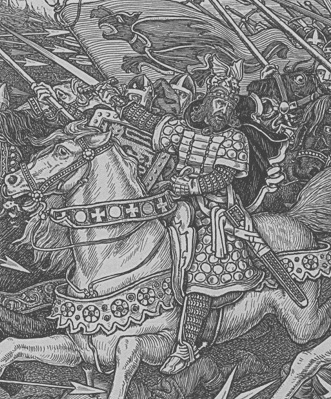
First of all, I saw some striking similarities between the two narrative's portrayal of battle scenes. On pages 34-38 in Malory's Book I, Arthur is fighting a very bloody battle.
Compare that description to Whyte's own words on pages 5-6 in his book.
The battles scenes, with the use of the horse, the spear, and the knight engaging in realistic (rather than romantic) warfare, is seen in both authors' works. Blood, wounds, chaos appear to be fundamental to their portrayal, conveying the frightening and dangerous aspects of these battles.
I also saw striking similarities between the two writer's use of celebration imagery for weddings, welcomings, and winnings in warfare. In Malory we see many knights coming together to celebrate the new King Arthur on pages 26-27.
Then we see an eerie echo on pages 352-353 of Whyte's book.
For both, in early Britain, and in King Arthur's time, celebrations were vast affairs for large numbers of people over an extended period of time. The evolution into the knights of the round table can clearly be seen in Skystone where a number of former Roman citizens develop a Roman enclave. They depend on each other's counsel, and protection, just as the later knights of King Arthur's time do.
I have mentioned above some very specific examples of the similarities between the two novels. However, Malory's portrayal of women as manipulative or objects of conquests and his mystical explanation of some events differs from Whyte's balanced perspective on women, and empirical grounding in presentation. Regardless, Whyte was obviously influenced by Malory in developing his ideas about the King Arthur's past.
II. 1.
As I mentioned in the previous short essay, there is a big difference between Malory and Whyte in their depiction of women. In Book I and II of Malory we see women portrayed as vehicles for passion, birth, and conquest. They are not viewed as partners in romantic love, but as the objects of lust. This is readily apparent in the seduction of Igraine, and Morgan Le Fay. Neither have relationships with their lovers before consummation and both result in pregnancies that change the course of history.
However, an essential aspect of the unions is that both involve some amount of secrecy. Deception is a key theme in Malory's book, so it isn't surprising that women would be connected to it, but it interesting the way it is done, and what it suggests about the role of women. For instance, this secrecy element can be seen in Varrus and his introduction to Luceiia, when he thinks she is not beautiful or worthy of his attentions. However, this deception is innocent compared to Malory's own "mistaken identities." No one is hurt, nor do complications arise in the Whyte text, unlike King Arthur's relationship with a sister he does not know he has, or the forced sexual communion of Igraine and Arthur's father Uther. The deception in Whyte does not put women in a dangerous light. However, in Malory, women and deception too often go hand in hand.
Women are also viewed as enchantresses, in Malory's writing, who have an interesting relationship to nature and the people around them. The Lady of the Lake is mentioned in Book I and she has powers to see truth and create deception. She can also be seen in another form (stone) in Whyte's book. Here she is comes from the mysterious skystone, and she has an intricate relationship to a powerful and unique sword. Women, as seen with the Lady of the Lake in both books, appear to have symbolic value as keepers of power and knowledge.
Another difference between Whyte and Malory is that one of the main goals for the various knights in King Arthur's time is to fight for the women they love. Just as I mentioned that women are often the object of conquest in Malory, women are also the purpose of conquest. Fighting occurs in Whyte, but never for the possession of a woman. However, Varrus does want to revenge the death of a woman he was once intimate with, however, she is not treated like an object to possess or impress.
Luceiia and Lynet are an interesting comparison because they play totally different roles in their respective books. In Whytes' work, Luceiia is one of the main characters who is an equal to the protagonist. She is educated, balanced, accepting, passionate, independent, and also intelligent--and Lynet appears not to have cornered the market on any of those characteristics. Lynet, in Malory's text, is a very minor character, with a short relationship with a only slightly more major character, Gareth. Additionally, Lynet is duped by Gareth, and ends up being his caretaker. Luceiia, on the otherhand, is a partner to Varrus, and is never manipulated by him. But Lynet makes her decisions out of prejudice, and she isn't quick to fix her mistakes. She is stubborn to the point of mishap.
However, one similarity you can see between the two characters is that they are both opinionated, strong-willed, and try to solve problems that are around them. Luceiia and Lynet are not passive. When Lynet needs to figure out how to solve a relationship problem between Gareth and her sister, she goes ahead and does it. Similarly, Luceiia is part of the reason Varrus ends up finding the skystone after all. In conclusion, the women in Malory and Whyte seem to serve different purposes. There appear to be some similarities between the female characters of the two books. However, I believe that the differing cultural influences at the time the two books were written resulted in differing portrayals of the fairer sex.
III. 2.
I think that Malory's Book II is related to Book III thematically, however, I believe that the two books serve different purposes in the context of the overall text. Book II shows the development of Arthur's power, and his ability to make decisions in light of the actions of his various knights. Additionally, he is becoming aware of what his role as king is, and how it must be more than a title. Balin ends up having the virtue and honor that Arthur lacks, and can do a mystical and amazing feat that Arthur can not. The rest of Book II involves the consequences of this action, and the resulting realization by Arthur that fate and deception sometimes go hand in hand.
In the next Book III, King Arthur begins to setup his kingdom and household by getting married. He begins to recede at this point, because in many ways his role is established and constant, and the knights around him are more varied and changing. Additionally, Arthur is tied up with affairs of the state, like knighting people. He can't go off on battles or adventures like he used to. This book then tells the various adventures of the knights. However, King Pellinor, one of his knights, ends up meddling with a damsel in distress, and killing the wrong people.
Here, just as in Book I, we see the problem of deception and the theme of justice. In developing the role of the Knight of the Round table, each story in Book I echoes the developing role of King Arthur in Book III. Balin, in his adventures in Book II, consequently, is not any worse than the knights in Book III. All are victims of deceptive people, environments, and their individual fates--just like King Arthur. The end result of their actions is not really the issue in comparing the various knights--it is whether they could have prevented any resulting problems or not and the motivations for going on the adventures that matters.
IV.
In Book III I mentioned how King Arthur "vanishes" and the focus is then on the various knights and their adventures. I likened Arthur to a stable foundation from which all other stories grow from. Arthur does change as a king and he appears to mature in his dealings with others. One example of this change is the difference between his earlier battles and the invasion of the Roman. In the first, Arthur passively goes to war to protect his kingdom. He is not skilled in being a King, or in being a warrior. He is unsure of how to act, and relies on Merlin for his council. He is not established as King yet, and does not have the loyalty he needs. The Knights of the Round Table do not exist in the early battles, so there is only a loosely affiliated group to depend on.
With the invasion of the Roman Empire, King Arthur makes an intellectual decision to protect his lands from Rome, and then later to expand those lands. However, at this point the issue almost appears to be nationalistic pride. He has a group of knights to rely on in making his decisions, and who like the idea of more power. He is organized in his actions and he behaves like a hero. Unlike the bloody, almost anonymous, conditions that were described in the early battles, we see a King gracefully engage in war.
The Accolon episode is interesting because it is more a personal quest or battle, than the other two battles I mentioned. This episode develops from a weird dreamlike state of impotence to an anonymous battle like we saw with Balin. Again, here we see the issue of deception. Morgan Le Fay traps him and then forces him to battle one of his knights. He is an action figure being manipulated, rather than the King he should be. He is put in the same position that many of his knights have been. He has ask himself, who to protect, who to attack?
The Accolon episode causes a personal transformation for Arthur. He grows from a naive, trusting person who is detached from the woes of his knights to a decisive, mature King who understands the role of deception in defeat. Perhaps this is the turning point for Arthur's style in battle, and why the preceding battles, and the later invasion attempt by Rome, are so different.
V. 2.
Finally, I think that Lancelot differs from the other knights depicted by Malory in many ways. Since Lancelot was created by a French writer during a different time than the earlier knights were created, Lancelot appears to reflect the cultural values and ideas on manhood that were not found in Welch or British stories.
First of all, Lancelot is inserted with no real history or relationship to the other characters. All we know is that he is a knight who is an unmatched hero. Book VII portrays Lancelot's quests as much more action oriented than the other knights' quests.
In these quests, Lancelot does not encounter the same problems with deception that the other knights had. For instance, he is enchanted, and falls asleep, just like Arthur, and he doesn't have any anxiety over this. He is a very "happy go lucky" character who does not deal with tragic consequences of his actions, like the other knights appear always having to do. As a side note, the use of humor in Malory's portrayal of Lancelot only reinforces the image of an easygoing nature. For instance, he finds himself, while sleeping (he sleeps more than any of the other knights), being kissed by a rough beard, and backs away without any anger.
Another important feature about Lancelot is that he is mostly alone. He encounters strangers, damsels, or briefly interacts with other knights, but he appears to live a solitary life. This might suggest a subtle shift from the community oriented Welsh or early British sources to the individualistic period of Chretien de Troyes.
Also, we see with Lancelot a number of dwarfs, enchantments, castles, magic, and damsels. This is the King Arthur image we expect, and yet it has nothing to do with King Arthur we read earlier in Malory. It is a benevolent universe that Lancelot is in.
Finally, with Lancelot, you have to say something about women. One thing that is noticeably different between Lancelot and the other knights is that Lancelot is the pursued. All the women seem to like Lancelot--he is the hunk of Camelot--and he just wants to be left alone. He loves Guinevere, however, unlike Arthur and Uther, he does not try to consummate the relationship when she is married. Morgan Le Fay even mentions this when she is trying to seduce him. She describes his attachment to Guinevere in terms of an almost courtly love notion. Since Guinevere was married, he must choose another object of his affection. In true romantic fashion, he proclaims his undying love for the Queen. This probably mirrors the courtly love ideal of Chretien de Troyes' time.
So, in conclusion, Lancelot was an interesting attempt to mediate the old King Arthur stories to the new sentiments of the later times. Obviously we can also see this attempt to modernize Arthurian legends in our own fiction and movies. However, hopefully, the King Arthur of old does not get left behind.